Roads
13,210 km of Autobahn and 37,746 km of federal roads (1 January 2025). Road transport carried about 70% of freight tonne-kilometres in 2024.
Policy overview
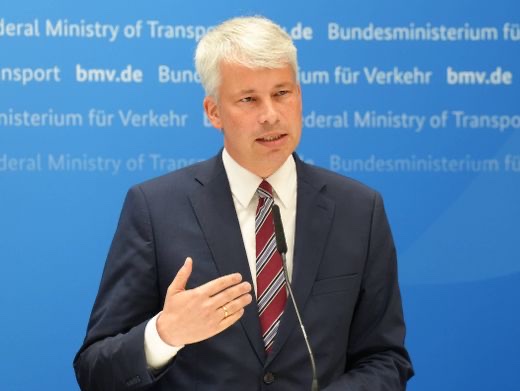
German transport policy is shared between three levels of government, spread across five modes of transport and funded from several pots of money. This sheet explains who does what, gives the essential figures for each area, collects Steffen Bilger's documented positions since he became Federal Minister for Transport on 29 July 2026, and links every detailed sheet on this site.
Section A — the federal frame
Germany is a federation of sixteen Länder (states). Transport is one of the policy fields where the constitution splits the work most finely, and that division explains much of the public debate: the federal minister is held responsible for things he controls directly, such as the motorways, and for things he only funds, such as the local bus.
The Basic Law (Grundgesetz) gives the federal government ownership of the federal railway infrastructure (Article 87e) and of the motorways (Article 90), and assigns the Länder a share of federal tax revenue for local public transport (Article 106a). Most transport law, from road traffic rules to vehicle approval and rail regulation, is federal. Delivery is mixed: since 2021 the motorways have been run by a federally owned company, Die Autobahn GmbH des Bundes, while the Länder administer the federal roads (Bundesstraßen) on the federal government's behalf. Buses, trams and regional trains are planned and ordered by the Länder, counties and cities.
The Federal Ministry for Transport (BMV) therefore works through three instruments: ownership (of Deutsche Bahn and the Autobahn GmbH), money (Einzelplan 12 of the federal budget plus the special fund for infrastructure) and law. The sheet on the ministerial office describes the ministry itself; the infrastructure investment sheet follows the money.
Responsibility matrix
A simplified map of who owns, decides and pays. "Lead" means primary responsibility; "Funds" means a significant financial contribution without operational control; "Shares" means joint decision-making. Details differ between Länder.
| Area | Federal government | Länder | Municipalities and counties |
|---|---|---|---|
| Motorways (Autobahn) | Lead Owner; Autobahn GmbH plans, builds and operates | — | — |
| Federal roads (Bundesstraßen) | Lead Owner and funder | Shares Administer on federal commission | Shares Some sections through larger towns |
| State and local roads | — | Lead State roads | Lead County and municipal roads |
| Rail network | Lead Owns DB; funds DB InfraGO's network; regulation via EBA | Funds Co-finance some projects | — |
| Long-distance trains | Shares Owner of DB; services run commercially | — | — |
| Regional trains | Funds Regionalisierungsmittel | Lead Plan and order services | — |
| Buses, trams, U-Bahn | Funds Infrastructure grants (GVFG) | Shares Legal framework, funding | Lead Plan, order and often operate |
| Deutschlandticket | Shares €1.5bn a year | Shares €1.5bn a year; set price in the transport ministers' conference | Shares Transport authorities implement |
| Inland waterways | Lead Federal waterways and locks | Shares Ports | Shares Ports |
| Aviation | Lead Air traffic control (DFS), aviation authority (LBA) | Shares Airport shareholders and approvals | Shares Airport shareholders |
| Road traffic law and safety | Lead Road Traffic Act and regulations | Shares Police and enforcement | Shares Local traffic authorities |
Policy areas
The essentials for each area, with the latest available figures. The figures describe the transport system, not the minister's record.
13,210 km of Autobahn and 37,746 km of federal roads (1 January 2025). Road transport carried about 70% of freight tonne-kilometres in 2024.
About 28,000 bridge sections on the Autobahn network, around 55% built before 1985; about 4,000 are due for modernisation by 2030. The Rhine bridge in Bonn was closed indefinitely in June 2026.
Long-distance punctuality was 60.1% in 2025 and 58.7% in the first half of 2026. The federal target is 70% by 2029.
Organised locally, part-funded federally. The Deutschlandticket will cost €66.80 a month from January 2027 and has around 14.5 million users.
4,235 million tonnes of goods moved in 2024: road 474.5 billion tonne-km, rail 133.3 billion, inland waterways 43.4 billion.
Low water on the Rhine, single-wagon rail freight and truck charging are current issues; federal support for single-wagon traffic reached €384m in 2026.
Digital train control (ERTMS) received €2.5bn from the special fund in 2026; a federal coordination office was set up in August 2026.
Bilger told the Bundestag that around €170bn is available for transport investment up to 2030, from the core budget and the special fund.
2,832 people died on German roads in 2025, 62 more than in 2024. DB Regio recorded 989 assaults on staff in the first half of 2026.
Transport emitted 146.3 million tonnes of CO₂ equivalent in 2025, up 1.5% on the year, according to the Federal Environment Agency.
Rural access depends on federal roads, regional rail ordered by the Länder and local bus networks; around €2.08bn is planned for municipal transport projects in 2027.
On the record
Each box sets what Bilger has said (with date and source) beside the policy context. Only positions documented since 29 July 2026 are listed here; earlier views are on the political positions sheet.
Called DB punctuality „völlig unzureichend" ("completely inadequate", translation) in Bild on 9 August 2026, and told the Bundestag on 8 September: Wer die Ziele erreicht, wird belohnt. Wer sie verfehlt, nicht.
("Whoever meets the targets is rewarded. Whoever misses them is not", translation.)
The federal government owns DB. Its 2025 agenda for rail set a 70% long-distance punctuality target for 2029. SPD, Greens and the passenger group Pro Bahn backed linking bonuses to targets. See rail.
Rejects a general speed limit (Bild, 9 August 2026) and prefers variable limits set by traffic telematics. To the Berliner Morgenpost (14 September) he said: Ein Tempolimit würde außerdem die Spaltung im Land noch einmal verstärken.
("A speed limit would also deepen the division in the country further", translation.)
Germany has no general Autobahn speed limit. The Greens called on Bilger on 8 August to introduce one as a climate measure; transport emissions rose in 2025.
Told Der Spiegel (26 September) he was "not at all satisfied" with the renovations so far: Man kann niemandem erklären, warum Pendlerstrecken so lange gesperrt werden und die Situation danach noch immer nicht besser ist.
("No one can explain why commuter lines are closed for so long and things are still no better afterwards", translation.)
DB InfraGO's programme of full closures for renovation was slowed by DB on 10 September 2026. See rail infrastructure.
On the cabinet decision of 7 October 2026: Wir leiten einen Paradigmenwechsel bei der Autobahnfinanzierung ein und schaffen mehr Spielraum für Investitionen in unsere Autobahnen.
("We are initiating a paradigm shift in motorway financing and creating more room for investment in our motorways", translation.)
The Autobahn GmbH is to be allowed limited borrowing from 2027 and a share of truck-toll revenue from 2028, with the federal government remaining sole owner. See investment.
Called the 2027 price of €66.80 "still a very attractive offer" (30 September 2026) and said the adjustments were necessary to maintain the service (Berliner Morgenpost, 14 September).
The price is set jointly with the Länder. Consumer and environmental groups criticised the rise. See public transport.
On e-fuels for aviation (21 September): eSAF ist für mich nicht nur eine Frage der Klimapolitik, sondern auch eine industriepolitische Chance.
("For me eSAF is not only a question of climate policy but also an industrial-policy opportunity", translation.) On automated vehicles (31 August): Autonomes Fahren bietet die Chance, Mobilität neu zu denken.
("Autonomous driving offers the chance to rethink mobility", translation.)
Germany, Austria and Luxembourg launched a joint eSAF funding auction, with up to €2bn from Germany. A €14m programme supports autonomous vehicles in public transport and freight. See future mobility.
Hub
Each sheet covers one part of the system: how it works, who is responsible, the figures, and what Bilger has said on the record.
Autobahn, federal roads and the Autobahn GmbH.
Open sheetAgeing structures and the modernisation programme.
Open sheetPunctuality, Deutsche Bahn and the bonus debate.
Open sheetDB InfraGO, corridor renovations and the Infraplan.
Open sheetLocal transport and the Deutschlandticket.
Open sheetRoad, rail and waterway freight.
Open sheetSupply chains and resilience.
Open sheetHow people travel and why it matters.
Open sheetERTMS, digital coupling and data.
Open sheetRoads, rail staff, airports and bridges.
Open sheetBudgets, the special fund and Autobahn financing.
Open sheetAutomation, alternative fuels and research.
Open sheetInfrastructure as a location factor.
Open sheetEmissions, climate targets and alternatives.
Open sheetRural access and links between regions.
Open sheet