Ministry · March 2018 – December 2021
Inside the ministry: Parliamentary State Secretary
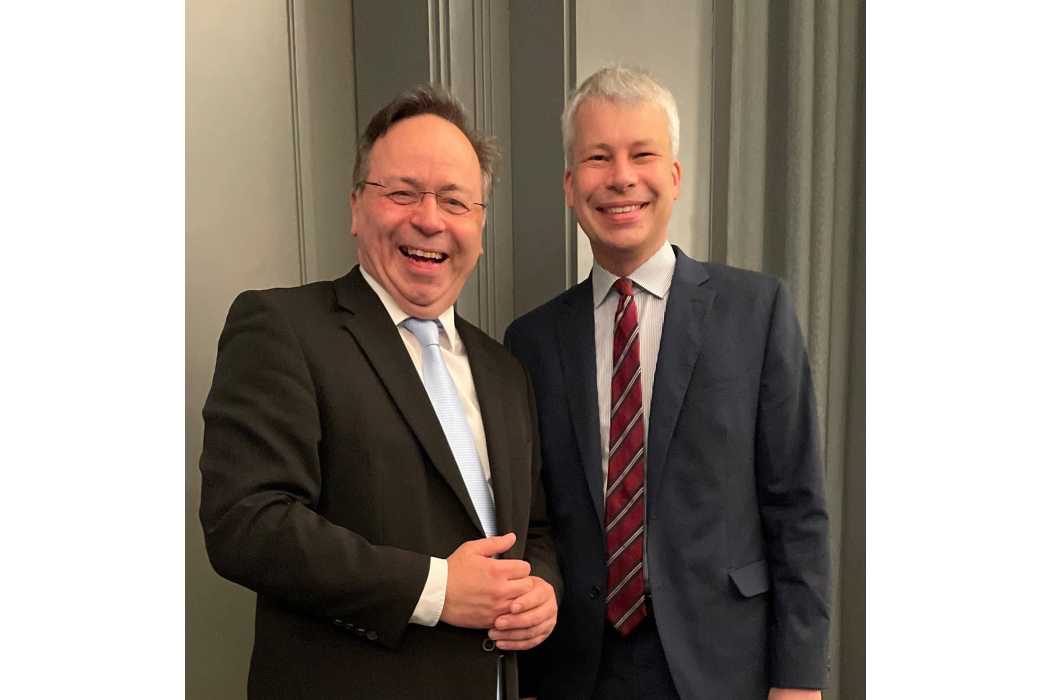
For almost four years Steffen Bilger served in the Federal Ministry of Transport and Digital Infrastructure under Minister Andreas Scheuer (CSU). He was responsible for roads, cars, alternative drives, aviation and digitalisation, and he was the Federal Government's coordinator for freight transport and logistics. It was his first executive office, and the one that tied him most closely to transport policy before he became minister in 2026.
The office
What a Parliamentary State Secretary is
German ministries have two kinds of state secretary. The difference matters for understanding what Bilger did, and what he did not do.
Political
- Must be a member of the Bundestag (Bilger kept his Ludwigsburg seat throughout)
- Appointed on the chancellor’s proposal in agreement with the minister; leaves office when the minister does
- Supports the minister politically and stands in for him in the Bundestag, the Bundesrat, committees and at public events
- Answers MPs' questions for the ministry in the plenary
Administrative
- A senior civil servant, not usually an MP
- Heads the ministry's administration and its departments
- Prepares and steers draft legislation and budgets inside the ministry
- Can be retired at any time as a "political civil servant"
The office of Parliamentary State Secretary was created in 1967 to link ministries more closely to parliament. Its holders have no department of their own; their authority comes from the minister, who decides which areas each one covers. In practice they divide the ministry's subjects between them, represent it at events, trade fairs and on visits and speak for the government in debates where the minister does not.
At the transport ministry from 2018 Bilger shared the role with Enak Ferlemann (CDU). Bilger described the division of labour himself in an interview in September 2018: he and Ferlemann had "split regional responsibilities between north and south" (translation), in addition to the division by subject.
The portfolio
In his own words
Ich bin zuständig für Straße, Auto, alternative Antriebe, Luftverkehr und Digitalisierung. Hinzu kommt noch meine Aufgabe als Koordinator der Bundesregierung für Güterverkehr und Logistik.
"I am responsible for roads, cars, alternative drives, aviation and digitalisation. I am also the Federal Government's coordinator for freight transport and logistics." (translation)
Steffen Bilger, interview with trans aktuell / eurotransport, 7 September 2018
- 01RoadsFederal motorways and trunk roads
- 02CarsVehicles, type approval, road traffic
- 03Alternative drivesElectric, hydrogen and other non-fossil propulsion
- 04AviationAir transport and air navigation
- 05DigitalisationDigital technology in transport
- +Logistics coordinatorFederal Government, from April 2018
Freight and logistics
The government's point of contact for logistics
In April 2018 the cabinet confirmed Bilger as the Federal Government's Coordinator for Freight Transport and Logistics. The post exists to give an industry that cuts across many ministries, from transport and economy to finance and labour, a single political contact. Logistics is one of Germany's largest economic sectors, and road haulage carries the large majority of its freight.
Ich freue mich auf die neue Aufgabe und bin ab sofort erster Ansprechpartner der Bundesregierung für alle Fragen rund um die Logistik.
"I look forward to the new task and am, as of now, the Federal Government's first point of contact for all questions concerning logistics." (translation)
Steffen Bilger, 11 April 2018, as reported by VerkehrsRundschau
According to the trade paper VerkehrsRundschau, his stated aims were to modernise the framework conditions for the industry and to draw up an "Innovationsprogramm Logistik 2030" together with it, with digitalisation as a central element. He also set out an environmental aim:
Ich werde mich auch dafür einsetzen, die Emissionen im Güterverkehr weiter zu reduzieren und Maßnahmen zur Verlagerung von Transporten auf Schiene und Wasserstraße zu unterstützen.
"I will also work to further reduce emissions in freight transport and to support measures to shift transport to rail and waterways." (translation)
Steffen Bilger, 11 April 2018, VerkehrsRundschau
His declared functions from this period reflect the portfolio. The Bundestag's register lists him, among other things, on the advisory board of the air navigation service provider DFS Deutsche Flugsicherung, on the advisory board of the aviation fuels initiative aireg, on a ministry advisory board on an "integrated energy concept 2050" and on the advisory board of the Bundesvereinigung Logistik, the logistics industry association. The present-day context of the subject is set out on the logistics and freight transport pages.
Positions and controversies
Diesel, technology openness and the toll
The documented statements from this period are few but clear. The table separates what Bilger said from the context in which he said it.
Diesel and drive technologies, 2018
Documented position
„In der Verkehrspolitik wird mir zurzeit vieles zu ideologisch diskutiert. Wer jetzt den Diesel verteufelt, hat nicht zu Ende gedacht."
"Too much in transport policy is currently being discussed too ideologically for my taste. Anyone who demonises diesel now hasn't thought it through." (translation) In the same interview: „Technologieoffenheit ist wichtig. Als Autobauerland Nummer eins muss es unser Ziel sein, bei jeder Technologie an der Spitze zu sein." ("Technology openness is important. As the number one car-making country, our goal must be to lead in every technology.") — trans aktuell / eurotransport, 7 September 2018.
Policy context
In 2018 the diesel emissions scandal was still unfolding, and German cities faced court-ordered driving bans for older diesel vehicles to meet air-quality limits, many of them following lawsuits by the environmental organisation Deutsche Umwelthilfe. Environmental groups have since criticised Bilger's technology-open line and his opposition to a motorway speed limit. His positions over time are collected on the political positions page.
The Deutsche Umwelthilfe motions, December 2018
Documented position
Bilger's CDU district association, Nordwürttemberg, which he has chaired since 2011, tabled motions at the CDU's 2018 federal party conference to strip the Deutsche Umwelthilfe of its charitable status and its right to bring collective lawsuits. Asked by ARD's Monitor, he said that anyone who went into the discussion as sharply as the DUH had to accept that its conduct could also be discussed.
Policy context
The motions were a party matter, not ministry business, but they came while Bilger was a member of the government. Critics, including the constitutional lawyer Joachim Wieland, objected to them. The episode is covered in full on the criticism and controversies page.
The Pkw-Maut
Documented position
No source consulted for this site attributes to Bilger any personal responsibility for the passenger-car toll, and none shows him as a witness before the Bundestag's committee of inquiry into it.
Policy context
The ministry concluded the operator contracts at the end of 2018, during Bilger's term. In June 2019 the European Court of Justice ruled the toll incompatible with EU law, and the project was cancelled. The contracts and their termination became the subject of a Bundestag committee of inquiry focused on Minister Andreas Scheuer.
What carries over
From deputy to minister
Bilger's time at the ministry is the obvious background to his appointment as Federal Minister for Transport in July 2026. He returned to a department that had changed: since May 2025 digital infrastructure has belonged to a separate ministry, so the house he now leads is narrower than the one he served in.
A secondary report from 2026 says that as Parliamentary State Secretary he was involved in funding programmes for electric vehicles, charging infrastructure and alternative drives for commercial vehicles, which fall squarely within the portfolio he described. This site has not found primary sources that credit him personally with specific national programmes of that period, such as the National Cycling Plan, the hydrogen programmes or the charging-infrastructure master plan, and so does not list them as his achievements.
Sources
- Deutscher Bundestag — Biography of Steffen Bilger (March 2018 – December 2021)
- Deutscher Bundestag — Biography archive, 19th term (declared functions)
- Deutscher Bundestag — Biography archive, 20th term (DFS and aireg advisory boards)
- Steffen Bilger — Politische Stationen (left committees on 14 March 2018)
- trans aktuell / eurotransport — Interview: Steffen Bilger, der Parlamentarische Staatssekretär im Gespräch (7 Sep 2018)
- VerkehrsRundschau — Das machen die neuen Staatssekretäre im Verkehrsministerium (11 Apr 2018)
- ARD Monitor — CDU gegen Deutsche Umwelthilfe (6 Dec 2018)
- Wikipedia — Steffen Bilger (Pkw-Maut contracts in his term; DUH motions)
- elektroauto-news — Steffen Bilger and electric mobility (2026; secondary)
- echo24 — Schnieder-Nachfolger Bilger: so stand er bisher zu Umwelt (2026)
- Organisational decree of the Federal Chancellor (6 May 2025)