Motorways and federal roads
13,210 km of Autobahn and 37,746 km of federal roads (1 January 2025). Ownership and funding of the Autobahn GmbH; the truck toll; road traffic law and vehicle approval.
The current office
Since 29 July 2026
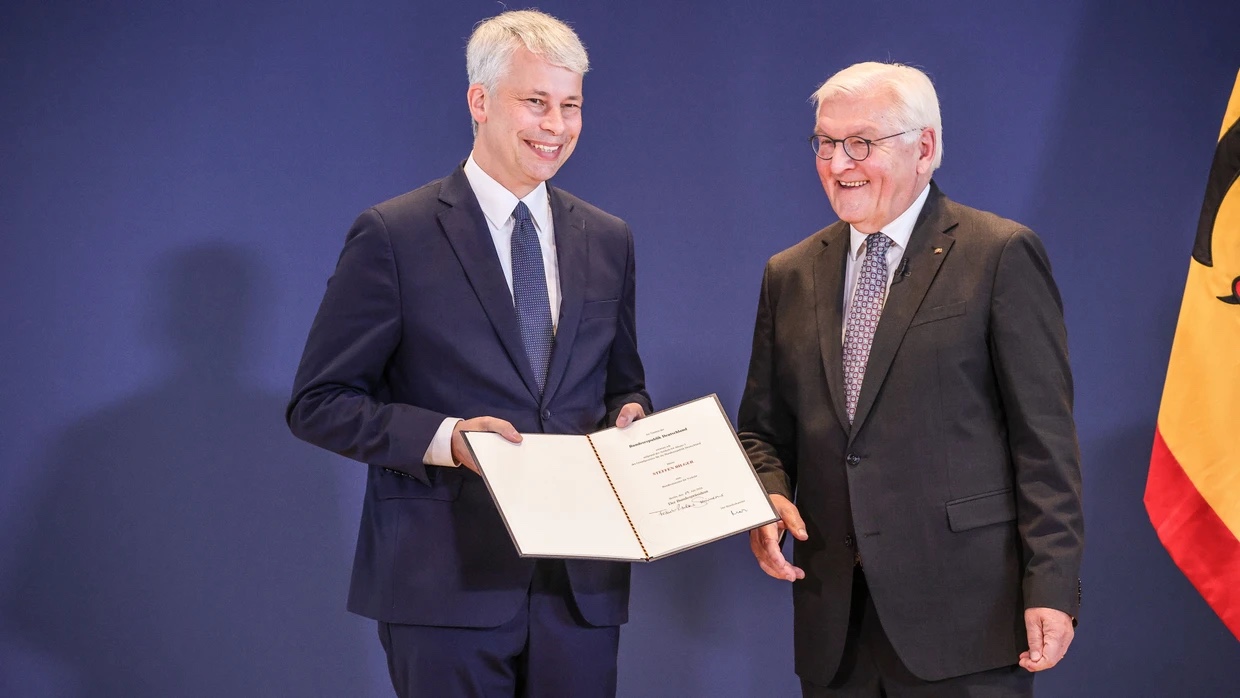
Steffen Bilger was appointed by Federal President Frank-Walter Steinmeier at Bellevue Palace in Berlin on 29 July 2026, after a cabinet reshuffle that removed his predecessor Patrick Schnieder. He leads the Bundesministerium für Verkehr (BMV), the federal ministry responsible for Germany's motorways, federal roads, the federally owned railway, the inland waterways and aviation oversight. This sheet sets out how he got the job, what the ministry is, what it spends, and what he has said he wants to do. As of 8 October 2026 he has been in office for 71 days.
Section A — the appointment
Bilger's appointment came out of a cabinet reshuffle that was not originally about the transport ministry. It began when Jens Spahn stepped down as leader of the CDU/CSU parliamentary group in the Bundestag, the German federal parliament, and Chancellor Friedrich Merz had to fill a chain of posts.
On Friday 24 July 2026 Merz announced the first round. Thorsten Frei moved from the Federal Chancellery to lead the parliamentary group; Health Minister Nina Warken became the first woman to head the Chancellery; CDU General Secretary Carsten Linnemann became Health Minister. Merz said further changes would follow "in the coming days".
One of them concerned transport. Berliner Zeitung reported persistent dissatisfaction with Patrick Schnieder's handling of the railways and infrastructure, adding that little progress was visible despite a record budget. The CDU finance politician Fritz Güntzler had been lined up as his successor, but he declined on the morning of 24 July; Bild reported that he sent Merz a text message at around four in the morning. Several days of uncertainty followed.
On the evening of Sunday 27 July the government spokesman, Stefan Kornelius, confirmed that Bilger would take over. Schnieder had asked Merz to dismiss him, describing the situation of the preceding days as „unwürdig" ("undignified", translation). Merz thanked him and said he regretted that "unforeseen developments" had prevented the handover from being communicated as planned. The Stuttgarter Zeitung called it the most controversial personnel change of the reshuffle within the CDU/CSU.
At the time Bilger, then 47, was First Parliamentary Manager (Erster Parlamentarischer Geschäftsführer) of the CDU/CSU group, the post that organises the group's parliamentary business. Euronews reported that he was described internally as "reliable and organisationally strong" (translation). His earlier career is set out on the sheets for his time as Parliamentary State Secretary in the transport ministry from 2018 to 2021 and as First Parliamentary Manager.
Under the Basic Law (Grundgesetz, Germany's constitution) federal ministers are appointed and dismissed by the Federal President on the Chancellor's proposal. At Bellevue Palace Steinmeier handed certificates of dismissal to Frei, Warken and Schnieder, and certificates of appointment to Warken (as Federal Minister for Special Tasks and head of the Chancellery), Linnemann (Health) and Bilger (Transport). According to ZDF, Steinmeier called the renewal of infrastructure „eine Herkulesaufgabe" ("a Herculean task", translation) that needs "time and persistence".
Bilger's first public line as minister, reported by ZDF, was: Wir brauchen einen pragmatischen, realistischen Blick auf die Verkehrspolitik.
("We need a pragmatic, realistic view of transport policy", translation.) To the Stuttgarter Zeitung he warned the next day that improvements would take time: Es wird nicht gelingen, dass von heute auf morgen alles gut ist.
("It won't be possible for everything to be fine overnight", translation.)
Handover, 29 July 2026
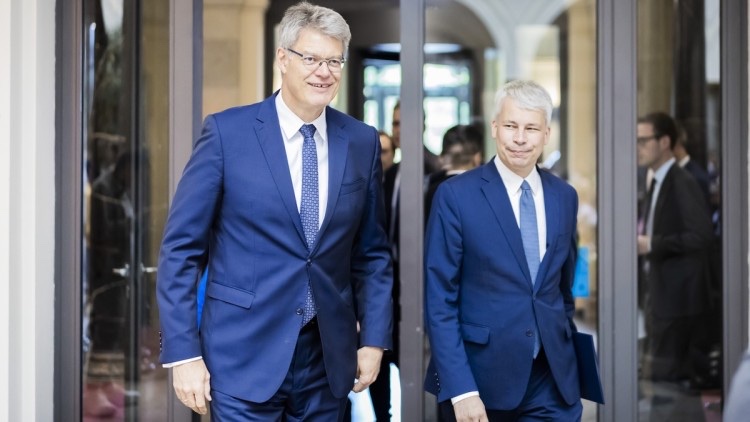
Schnieder, minister since May 2025, handed the ministry over in Berlin on the afternoon of the appointment. The ministry's press release on the handover (no. 070/2026) carried one line from the new minister, which has since served as a short statement of intent. Videos of both handover speeches are embedded in the ministry's press release.
Verkehrsinfrastruktur muss für die Menschen da sein.
"Transport infrastructure must be there for people." (translation)
Steffen Bilger, handover at the Federal Ministry for Transport, 29 July 2026 — BMV press release 070/2026
Section B — the oath
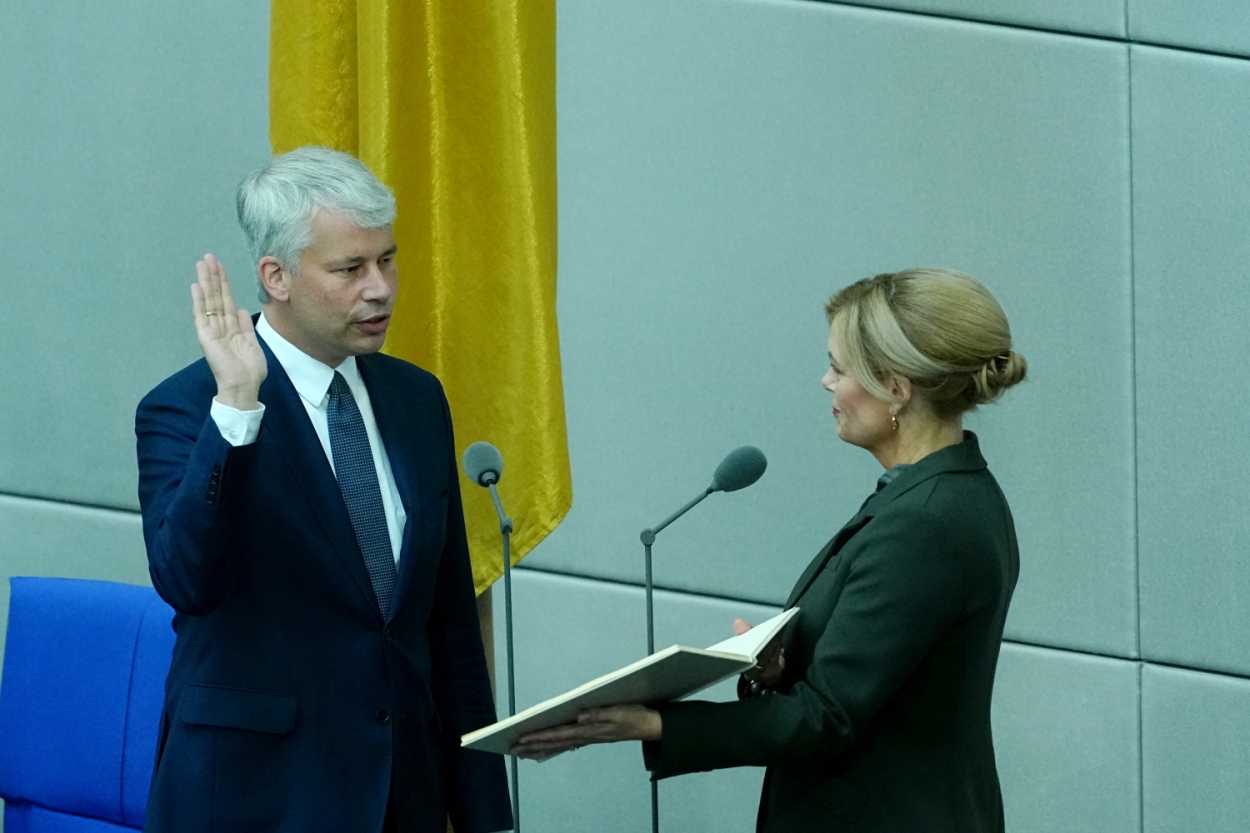
Article 64 of the Basic Law requires federal ministers to swear an oath before the Bundestag. Bilger and Linnemann did so on Tuesday 8 September 2026, in a short ceremony in the plenary chamber led by Bundestag President Julia Klöckner (CDU). Both used the religious formula „So wahr mir Gott helfe" ("so help me God").
The oath came just under six weeks after the appointment because parliament was in its summer recess. Steinmeier had noted at Bellevue that the ministers would take the oath at the first sitting after the break. Some constitutional lawyers argued that the Basic Law requires the oath to be sworn upon taking office, not weeks later; the government justified the wait with the cost of convening a special session.
The same day he gave his first speech as minister, opening the first reading of the 2027 transport budget. The speeches sheet covers it in full.
The institution
Since May 2025 the BMV has been a transport ministry in the narrow sense: the organisational decree of 6 May 2025 moved the digital portfolio to a new Federal Ministry for Digital Affairs and State Modernisation. The BMV has seats in Berlin (Invalidenstraße) and Bonn.
Germany has two kinds of state secretary. The two Staatssekretäre (Stutz, Schnorr) are senior civil servants who run the administration. The two Parlamentarische Staatssekretäre (Hirte, Lange) are members of the Bundestag who support the minister politically, a post Bilger himself held in this ministry from 2018 to 2021.
The ministry's portfolio includes, among others, the Federal Railway Authority (EBA), the Federal Motor Transport Authority (KBA, Flensburg), the Federal Aviation Office (LBA, Braunschweig), the Federal Office for Logistics and Mobility (BALM), the Federal Highway Research Institute (BASt), the Federal Trunk Road Authority (FBA), the German Weather Service (DWD), the Waterways and Shipping Administration and the independent accident investigation bodies for rail, air and maritime transport. On 1 August 2026 Alexander Schott became president of the LBA.
Die Autobahn GmbH des Bundes has planned, built and run the motorways since 2021 and is wholly federally owned. Deutsche Bahn AG is also wholly owned by the federal government; its infrastructure subsidiary DB InfraGO runs the rail network. The ministry manages these holdings through its budget and shareholdings department, which is why questions such as DB managers' bonuses land on the minister's desk. See rail and road infrastructure.
Responsibilities
Federal responsibility is broad but not unlimited. Buses, trams and regional train contracts are organised by the Länder (states) and municipalities, even where federal money pays for much of them. The transport policy sheet maps the division in detail.
13,210 km of Autobahn and 37,746 km of federal roads (1 January 2025). Ownership and funding of the Autobahn GmbH; the truck toll; road traffic law and vehicle approval.
Owner of Deutsche Bahn. Funds the roughly 33,400 km DB network and sets targets for it; regulation through the Federal Railway Authority. See rail infrastructure.
About 7,300 km of inland waterways plus maritime waterways, run by the Waterways and Shipping Administration, including locks such as the Kachlet double lock on the Danube.
Air traffic control through DFS, aviation safety through the LBA, and measures such as drone detection at major airports. See transport safety.
Federal money for local public transport (Regionalisierungsmittel and the GVFG programme) and the federal share of the Deutschlandticket. See public transport.
Drafting federal transport laws, from planning acceleration to the new financing structure for the Autobahn GmbH approved by cabinet on 7 October 2026.
Budget
The ministry's budget is "Einzelplan 12" of the federal budget. Since 2025 a large share of transport investment has come from the special fund for infrastructure and climate neutrality (SVIK) rather than the core budget. Full detail is on the infrastructure investment sheet.
Section C — early priorities
Day 1 to day 71
Seventy-one days is a short time in a ministry. The table separates what Bilger has said he wants (stated priorities, with where he said it) from what has happened so far. Many of the developments are decisions by others (Deutsche Bahn, the Länder, the cabinet as a whole) and are not presented as his personal achievements.
Stated DB long-distance punctuality is "completely inadequate"; managers' bonuses should depend on federal targets (Bild, 9 August; budget speech, 8 September).
Status Target remains 70% by 2029. No change to DB's bonus rules had been published in the sources reviewed. Long-distance punctuality was 58.7% in the first half of 2026.
Stated Lines closed for months "must work noticeably better afterwards" (budget speech); "not at all satisfied" with implementation so far (Der Spiegel, 26 September).
Status On 10 September DB chief executive Evelyn Palla announced fewer renovations per year; the revised concept is being agreed with the ministry. See rail infrastructure.
Stated A "paradigm shift" in road financing, with borrowing by the Autobahn GmbH (budget speech).
Status Cabinet approved the new financing structure on 7 October 2026. It still needs parliamentary approval.
Stated Safety on trains is "a basic precondition" for public transport (10 August); support for bodycams for conductors (budget speech).
Status DB Regio began a bodycam audio pilot on 1 October. A law on tougher penalties for attacks was still in government coordination in late August, according to the Justice Ministry.
Stated "If a drone appears near an airport, we need to know early" (5 October).
Status Systems in operation or being switched on at all eight large airports; the first expansion stage was close to completion on 5 October.
Announced Single-wagon rail freight (+€84m), digital automatic coupling (about €36m), autonomous driving (€14m), a truck fast-charging network (about €1bn) and e-fuels for aviation (up to €2bn).
Status Funding calls opened or programmes launched. Effects on traffic, emissions or costs cannot yet be measured.
Reception
A new minister arriving mid-term draws both demands and scepticism. The positions below are documented in the sources listed at the end of this page.
SPD transport politician Isabel Cademartori said on 27 July that there was "really no time for a long settling-in period" (translation). Handelsblatt wrote on 23 August that Bilger was delivering the public communication Merz had missed under Schnieder, noting his appearance on ARD's Maischberger talk show.
ZDF and Logistik Heute pointed out on 27 July that the special fund concentrates on maintenance and that core-budget gaps of billions open up from 2028, leaving new rail and motorway projects underfunded.
Tarek Al-Wazir (Greens) said the budget had halved from about €50 billion to €26 billion, leaving too little for investment, and that no new rail projects could start in 2027. Sascha Wagner (Left) called the change of minister a "political farce" (translation). Wolfgang Wiehle (AfD) wanted more money for Autobahn repairs.
The Greens called on 8 August for Bilger to act as a "climate minister" as well, including a motorway speed limit, which he has rejected. Pro Bahn and Allianz pro Schiene set out demands on punctuality and rail funding; see criticism and controversies.