Transport system · Regions and borders

Regional connectivity

Whether a village has a bus, whether two neighbouring Länder share a bridge, whether a student in Görlitz can take the train to Wrocław: regional connectivity is where federal, state and municipal responsibilities meet, and where European borders run through daily life. This sheet explains how that system is organised and what Federal Minister Steffen Bilger has decided about it.

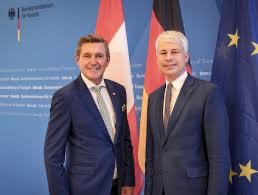
Steffen Bilger standing beside another man in front of the Austrian, German and European Union flags at the Federal Ministry for Transport
Steffen Bilger at the Federal Ministry for Transport, in front of the Austrian, German and EU flags. Cooperation with neighbouring countries is part of regional transport policy.

Who does what

Four levels, one journey

A single trip from a village to a neighbouring country can involve four levels of government. Germany's federal system spreads the responsibility, and the money, across all of them.

  1. Level 1

    European Union

    Sets common rules and the trans-European transport network (TEN-T) corridors. Approves state aid, as for the eSAF scheme agreed with Austria and Luxembourg.

  2. Level 2

    Federal government

    Owns Autobahns, federal roads, the federal rail network and the federal waterways, including the Kiel Canal. Funds regional rail through regionalisation money (Regionalisierungsmittel). Under the Municipal Transport Financing Act (GVFG) it pays grants for municipal transport infrastructure; the 2027 draft plans around €2.08 billion.

  3. Level 3

    Länder

    Order and pay for regional train services, and plan and build federal roads on the federal government's behalf. They also own the state roads and coordinate with each other in the Conference of Transport Ministers, which also sets the Deutschlandticket price with the federal government.

  4. Level 4

    Districts and municipalities

    Run or commission local buses and trams and maintain local roads and many bridges. In rural districts they decide how often the bus runs.

Why this matters for the ministerFor most connections that matter in rural areas, such as the village bus, the regional train and the district road, the federal minister is a funder and rule-setter, not an operator. His direct levers are federal infrastructure, federal money and negotiation with the Länder.

Diagram

Where the documented decisions are

A schematic, not to scale, placing the regional and cross-border decisions from Bilger's first ten weeks in office. Numbers refer to the case files below.

Schematic outline of Germany with five numbered markers: 1 Kiel Canal in the north, 2 the German–Polish border in the east, 3 the B 293 Rhine bridge between Wörth and Karlsruhe in the south-west, 4 Austria to the south-east and Luxembourg to the west for eSAF cooperation, 5 the Danube at Passau. 1 2 3 4 4 5
  1. 1Kiel Canal · leisure-boat fee abolished from 2027; Rader Hochbrücke visit
  2. 2German–Polish border · friendship pass for 60,000 young people
  3. 3Wörth–Karlsruhe · B 293 second Rhine bridge between two Länder
  4. 4Austria and Luxembourg · joint eSAF support scheme
  5. 5Danube at Passau · Kachlet lock overhaul begins

Section A — case files

Documented decisions

1

Kiel Canal: free passage for leisure boats

The Kiel Canal (Nord-Ostsee-Kanal) is a federal waterway almost 100 kilometres long. It links the North Sea and the Baltic and saves ships about 450 kilometres compared with the route around Denmark. On 14 September 2026 the ministry announced that the transit fee for sports and leisure boats will be abolished from 1 January 2027. About 10,000 boats a year will each save between €12 and €43 per transit, depending on length. The ministry says the cost of collecting the fee now exceeds what it brings in. The regulation includes further simplifications for shipping.

Wir wollen Bürokratie dort abbauen, wo sie den Menschen keinen Mehrwert bringt.

“We want to cut bureaucracy where it brings people no added value.” (translation)

Steffen Bilger, BMV press release 085/2026, 14 September 2026

On his summer tour Bilger also visited the Rader Hochbrücke, which carries the A 7 over the canal and is being replaced (see bridges).

2

German–Polish friendship pass

On 9 September 2026 the ministry announced a "German–Polish friendship pass". It marks the 35th anniversary of the 1991 German–Polish treaty on good neighbourly relations. Young people aged 18 to 27 living in Germany or Poland could apply from 15 to 22 September for a free Interrail pass. It is valid for seven travel days within one month in the neighbouring country, plus a return trip from home to the border. In all, 60,000 passes are available, 30,000 for each country, valid from 1 November 2026 to 31 October 2027. In the ministry's announcement Bilger described the pass as making the close partnership between the two countries tangible for the younger generation.

3

B 293: a bridge between two Länder

The planned second Rhine bridge between Wörth (Rhineland-Palatinate) and Karlsruhe (Baden-Württemberg) shows how a federal road project depends on two state governments. The original 2017 plan approvals were challenged in court. On 15 September 2026 the federal ministry approved revised planning documents, so both Länder can now apply for supplementary approval. The ministry puts the total at about €475 million.

Dies ist ein wichtiger Schritt zum Neubau der B 293, auf den die Region dringend wartet.

“This is an important step towards the new B 293, which the region is urgently waiting for.” (translation)

Steffen Bilger, BMV press release 086/2026, 15 September 2026
4

Austria and Luxembourg: a joint eSAF scheme

On 21 September 2026 Germany, Austria and Luxembourg launched joint support for electricity-based aviation fuel. Germany is contributing up to €2 billion and each partner up to €60 million, with supported volumes shared in proportion. The scheme still needs EU state-aid approval. It is an industrial project rather than a regional one, but it shows the cross-border side of the ministry's work. Details are on future mobility.

5

Danube: the Kachlet lock

On 3 August 2026 Bilger broke ground in Passau for the €380 million overhaul of the Kachlet double lock on the Danube, built between 1922 and 1927. The Main–Danube waterway links the North Sea with the Black Sea. The ministry says the federal government is investing about €3.5 billion in Bavarian waterways up to 2029.

Section B — rural areas

Rural connections

In rural Germany the car remains the main means of transport. Nationally, 65% of employed people drove to work in 2024, and in rural areas the alternatives are often few.

Federal policy reaches rural areas mainly through money and infrastructure. That includes regionalisation funds for the trains the Länder order, GVFG grants for municipal projects, the federal roads that link small towns to the Autobahn network, and since 2023 the Deutschlandticket, which is valid on every rural bus as well as in the cities. The ticket helps most where there is a bus to use it on. Where services are thin, its value is limited.

Bilger's first rural-specific initiative is the €14 million funding call for autonomous vehicles in public transport and freight, opened on 31 August 2026. He linked it explicitly to the countryside: Gerade in ländlichen Regionen und in städtischen Randlagen können autonome Fahrzeuge das öffentliche Verkehrsangebot sinnvoll ergänzen. ("In rural regions and on the edges of cities in particular, autonomous vehicles can usefully complement public transport", translation.) The programme is small, and automated rural services are still at the pilot stage (see digital mobility).

Bridge closures show the opposite side of regional connectivity. When a motorway bridge such as the Rahmede valley bridge on the A 45 closes, the detour runs through the nearest town for years. The bridge modernisation programme is therefore also a regional programme. Questions of regional economic development are discussed on regional development.

Section C — assessment

A mixed picture

Bilger's documented regional decisions are concrete but modest in scale: a fee abolished, a planning step approved, a youth rail pass, a lock overhaul begun and a pilot funding call. None of them alone changes how well a rural district is connected. The larger regional questions, such as how much operating money flows to regional rail and buses, how fast bridges are replaced and whether the Deutschlandticket stays affordable, are decided in budget negotiations and in the Conference of Transport Ministers. There the federal minister has to negotiate with sixteen Länder.

The cross-border dimension is more visible than is usual for a transport minister's first weeks. The friendship pass and the eSAF scheme show a European emphasis that fits his long-standing membership of the pro-European Europa-Union Deutschland, as listed on German Wikipedia. Whether that emphasis brings more cross-border rail services, which are often the weakest link for border regions, has yet to be seen. See also mobility and public transport.