One owner, many operators
Deutsche Bahn AG is wholly owned by the federal government. Its subsidiary DB InfraGO runs a network of roughly 33,400 kilometres of track, stations and power supply; other DB companies run long-distance trains, regional trains and freight.
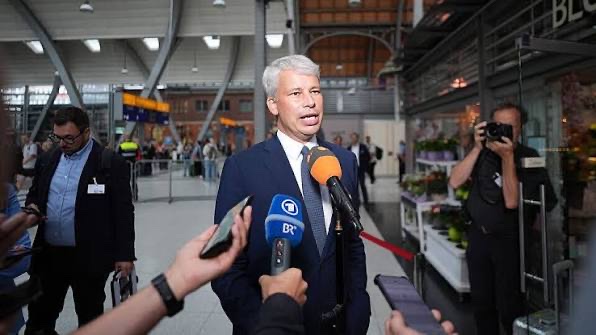
The network is open to competitors. Private companies win many regional rail contracts tendered by the Länder, and freight operators compete with DB Cargo. In long-distance travel DB is dominant, though new entrants are appearing: in his interview with Der Spiegel on 26 September 2026, Bilger welcomed the planned market entry of the Italian operator Italo, saying competition brings customers benefits, but cautioned that new services should not reduce connections to smaller cities or overload the network further.
Responsibility is divided. The federal government owns and funds the infrastructure under Article 87e of the Basic Law; the Länder order and pay for regional services with federal money (see public transport); long-distance trains are run commercially. The renovation of the network itself is covered on the rail infrastructure sheet.
The numbers behind the frustration
DB counts a train as punctual if it arrives less than six minutes late; cancelled trains are not included in the figure. On that measure long-distance services fell from 62.5% in 2024 to 60.1% in 2025 and 58.7% in the first half of 2026. Regional trains do much better, at 88.7% in 2025.
Bilger has not presented the target as easy. To Der Spiegel he said: Bis 2029 sollen zum Beispiel 70 Prozent der Fernzüge pünktlich kommen. Das klingt zwar nicht nach viel, aber ist angesichts des Sanierungsstaus bei der Schiene schon ziemlich ambitioniert.
("By 2029, for example, 70% of long-distance trains should be on time. That doesn't sound like much, but given the rail maintenance backlog it's quite ambitious", translation.) To Bild he added that 100% would not be achievable in the foreseeable future.
Evelyn Palla and the agenda for satisfied customers
Evelyn Palla has been chief executive of Deutsche Bahn since October 2025. She was named under the federal government's „Agenda für zufriedene Kunden auf der Schiene" (Agenda for satisfied customers on the railway), presented on 22 September 2025 under Bilger's predecessor Patrick Schnieder. The agenda set the 70% long-distance punctuality target for 2029 and proposed Dirk Rompf as head of DB InfraGO.
Bilger planned to meet her on his second day in office; he told the Stuttgarter Zeitung on 30 July that improvements would take time and that renovation would mean disruption and, on the railways, delays.
Bonuses tied to targets
The first public dispute of Bilger's term concerned managers' pay. In Bild on 9 August 2026 he called DB's punctuality "completely inadequate" and said the government would set clear targets in its agreements with DB, with consequences if they were missed. ZDF quoted him the same day:
Es wird sich konkret auf die Bonuszahlungen von Bahnmanagern auswirken, wenn die Ziele, die der Bund vorgibt, nicht eingehalten werden.
"It will have a concrete effect on rail managers' bonus payments if the targets set by the federal government are not met." (translation)
Steffen Bilger, 9 August 2026 — ZDFheute
- 65% payment begins
- 67.5% target fully met
- 70% 150% payout
DB initially did not comment. The SPD, the Greens and the passenger association Pro Bahn supported the idea. Bilger repeated it in his budget speech on 8 September: Wer die Ziele erreicht, wird belohnt. Wer sie verfehlt, nicht.
("Whoever meets the targets is rewarded. Whoever misses them is not", translation.) He framed it as the return for federal money: more punctuality, better processes and fewer disruptions. As of 8 October 2026 no revised bonus rules had been published in the sources reviewed for this sheet.
"Delays should count from three minutes"
How punctuality is measured
Pro Bahn, 10 August 2026
Chair Lukas Iffländer demanded a stricter definition: „Verspätungen zählen ab drei Minuten wie in der Schweiz statt ab sechs Minuten, und ausgefallene Züge gelten als verspätet." ("Delays should count from three minutes, as in Switzerland, instead of six, and cancelled trains should count as late", translation.) He warned that managers had gamed the metrics before.
Bilger's framing
Bilger has acknowledged the system's limits: Wir haben das System Bahn damit ein Stück weit überfordert.
("We have overloaded the rail system to some extent", translation; Berliner Morgenpost, 14 September 2026.) No statement by him on changing the six-minute definition was found.
The rail alliance Allianz pro Schiene put five demands to the new minister on 19 August 2026, including stronger federal steering of DB and opposition to planned cuts to rail freight support. They are listed on the rail infrastructure sheet. More criticism of his record is collected under criticism and controversies.
Where rail money comes from
Since 2026 most money for maintaining the rail network has come from the special fund for infrastructure and climate neutrality: €16.3 billion in 2026. The core budget line for federal railways fell correspondingly, from €12.6 billion in 2025 to €2.69 billion in 2026, and is planned at €3.0 billion in 2027. In his budget speech Bilger said rail funding would rise by €300 million in 2027 and by €1.8 billion in total up to 2030.
Some subsidies shrink in the 2027 draft: support for rail freight track-access charges falls from €265 million to €200.26 million, and the subsidy for long-distance passenger track-access charges from €200 million to €5.34 million. Rail associations and the Greens criticised these cuts; the details are on the infrastructure investment sheet.
Single wagons and digital couplings
Single-wagon traffic, in which individual wagons from different customers are collected and assembled into trains, is costly to run but important for industry. On 28 August 2026 the ministry added €84 million to its 2026 support. On 4 September it launched a funding call of around €36 million for "pioneer trains" fitted with the Digital Automatic Coupling (DAK), which connects wagons, air and data lines without manual work. Bilger: Die Digitale Automatische Kupplung stellt eine bedeutende Modernisierung für den Schienengüterverkehr dar.
("The Digital Automatic Coupling represents a major modernisation of rail freight", translation.) See freight transport.
ERTMS: the European signalling standard
The European Rail Traffic Management System (ERTMS) replaces lineside signals with digital train control, allowing more trains on the same track. The special fund provided €2.5 billion for ERTMS in 2026. On 13 August 2026 the steering committee of a new ERTMS coordination office was constituted and Florian Böhm was appointed as its head (ministry press release of 14 August); the office is based at the ministry in Berlin. Progress on rollout is tracked on the digital mobility sheet.
Staff and passengers
DB Regio recorded 989 assaults on its staff in the first half of 2026, and a conductor, Serkan Çalar, was killed during a ticket check in February 2026. Bilger called the figures and staff accounts „erschütternd" ("shocking", translation). The response, from bodycams with audio to a planned law on tougher penalties, is set out on the transport safety sheet.