Representation
Winning Ludwigsburg five times in a row, keeping a constituency office and taking local concerns to Berlin. Constituency · Ludwigsburg
Parliamentary work · 2009–2026
Steffen Bilger has been a member of the German Bundestag for seventeen years. In that time he has represented a constituency, sat on committees, spoken in the plenary, organised his parliamentary group, served in government twice and, in opposition, held government to account. This page brings those strands together and points to the detailed sheets.
Overview
Each lane shows one kind of role and when he held it. The constituency lane runs unbroken; everything else changes roughly every four years.
Kinds of work
A member of the Bundestag does several jobs at once. Bilger's career has given each of them a different weight at different times.
Winning Ludwigsburg five times in a row, keeping a constituency office and taking local concerns to Berlin. Constituency · Ludwigsburg
Nine years on the transport committee, plus the Joint Committee, the Mediation Committee, the Wahlausschuss and advisory councils. Committee work
Speeches on transport, environment, energy and agriculture, and short procedural interventions as group manager. Questions and debates · Speeches
Chair of the Junge Gruppe, deputy group chair and First Parliamentary Secretary: the work of holding a group together. Leadership
Speaking for a ministry in parliament, first as Parliamentary State Secretary, now as minister. State Secretary · Minister
Oversight
Parliament's second great task, after passing laws, is holding the government to account. Bilger has done it from the opposition benches and been on the receiving end from the government bench.
In the opposition years from 2021 to 2025 the CDU/CSU used the full set of parliamentary instruments against the Scholz government. Bilger was involved in several documented cases. On 19 April 2023 he opened an Aktuelle Stunde (topical debate) that his group had requested on the continued use of nuclear power. On 3 March 2023 he spoke for two CDU/CSU motions on the EU's Euro 7 emissions standard and on climate-neutral fuels, which were later rejected by the governing majority. On 1 December 2023 he spoke in the first reading of a CDU/CSU motion against a ban on climate-neutral combustion engines. Motions of this kind rarely pass when tabled by the opposition; their purpose is to force a debate and put the government's position on record.
In government, the direction reverses. As Parliamentary State Secretary from 2018 to 2021 Bilger spoke for the transport ministry in the Bundestag. Since July 2026 he answers to parliament as minister: on 8 September 2026 he took the oath of office before the Bundestag and, the same day, presented his ministry's draft budget for 2027 and faced replies from the AfD, the Greens and the Left. Ministers can also be summoned to committees and must take part in the weekly government question time when it is their turn.
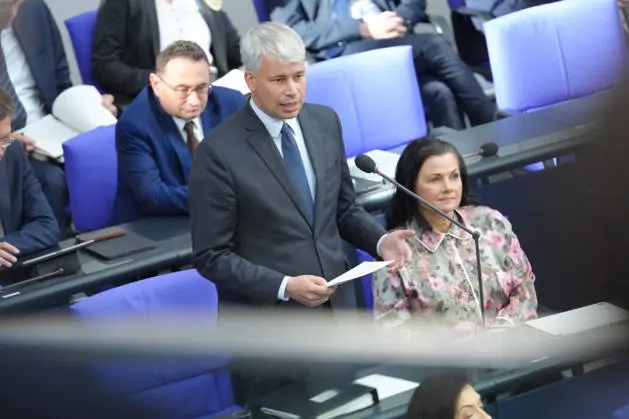
Between those two positions lies a third kind of work that belongs to neither government nor opposition: the procedure of the house itself. As First Parliamentary Secretary Bilger negotiated the agenda with the other groups and spoke on procedural motions, for example on 11 July 2025, when he moved to take three constitutional judge elections off the agenda, and on 16 September 2025, when he defended shorter debating times in a budget week.
Inside the group
Much parliamentary work happens in circles that never appear on the plenary record. The CDU/CSU group's own website lists Bilger as a member of three of its internal groupings: the Arbeitnehmergruppe (employees' group), the group for expellees, repatriates and German minorities, and the Parlamentskreis Mittelstand (small and medium-sized business circle).
From 2009 he was deputy chair of the Junge Gruppe, the caucus of the group's younger MPs, and its chair from 2014 to early 2018. The same caucus later caused him difficulty as First Parliamentary Secretary, when it opposed the coalition's pensions package in 2025. According to Wikipedia, citing the Ludwigsburger Kreiszeitung, he also belongs to the "Pizza Connection", an informal discussion circle of CDU/CSU and Green MPs.
The detailed sheets
Each sheet takes one part of the parliamentary record and sets out the sources.
Five elections, five terms, and how his responsibilities evolved.
Open sheetThe direct mandate, the results ledger and the sixteen municipalities.
Open sheetMemberships by term and what each body does.
Open sheetDocumented plenary appearances and the instruments of scrutiny.
Open sheetRepresenting the transport ministry, 2018–2021.
Open sheetDeputy chair in opposition, then manager of the majority.
Open sheetThe judge election, the pensions vote and the arithmetic of 316.
Open sheetBills and motions connected with his roles.
Open sheet