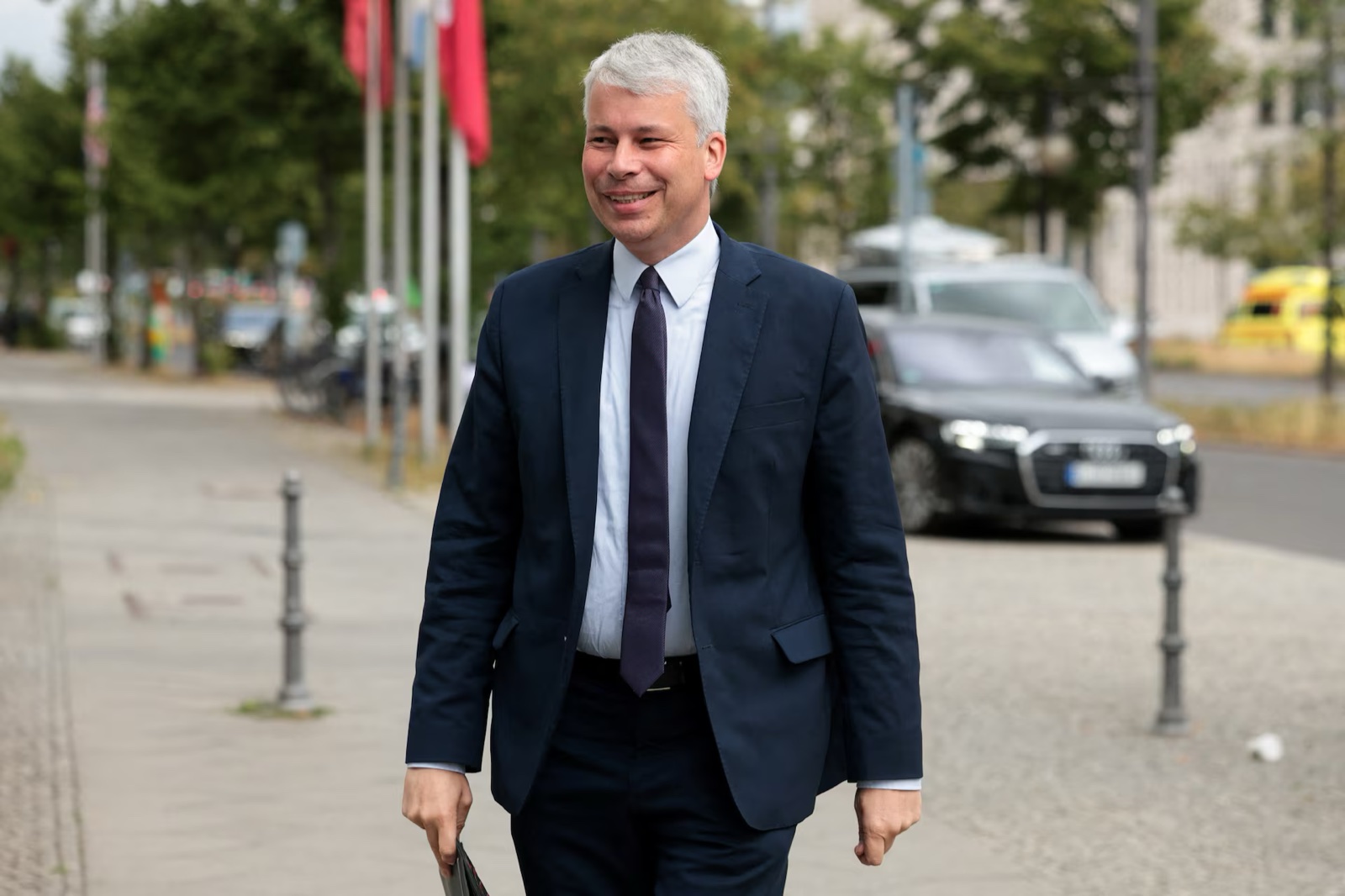
Who is Steffen Bilger?
Steffen Bilger is a German Christian Democrat (CDU) politician and lawyer. Since 29 July 2026 he has been Federal Minister for Transport in the government of Chancellor Friedrich Merz, and since 2009 he has been the directly elected Member of the Bundestag, the federal parliament, for the constituency of Ludwigsburg in Baden-Württemberg.
His career has two constant threads. One is transport: he sat on the Bundestag's transport committee from his first term, served from 2018 to 2021 as Parliamentary State Secretary in the federal transport ministry and now leads that ministry. The other is party and parliamentary organisation: he chaired the Junge Union in Baden-Württemberg, has led the largest CDU district association in the state since 2011, and spent 2021 to 2026 in the leadership of the CDU/CSU parliamentary group, latterly as the official responsible for organising its majorities. This biography sets out what is documented about each stage. Where sources disagree, or where the record says nothing, the text says so.
Early life
Bilger was born on 16 February 1979 in Schongau, a small town in Upper Bavaria. His full name, as recorded in official election results, is Steffen Rudi Bilger. He grew up in Backnang, a town of the Rems-Murr district north-east of Stuttgart, and that Württemberg setting rather than his Bavarian birthplace shaped his early political life. Published sources do not describe his childhood in any detail, and this site does not fill that gap with anecdote. A newspaper profile cited by German Wikipedia reports his parents' professions; because that print article could not be checked, they are not repeated here.
He is Protestant, has been married to Isabell Bilger since 2013 and has three children. These are the private details he has chosen to publish; the early life page explains what else is, and is not, on the record.
Education
Bilger took his Abitur, the German university-entrance qualification, at the Max-Born-Gymnasium in Backnang in 1998. He then did his Zivildienst, the civilian service that young men who declined military service had to complete while conscription was in force, at the Erlacher Höhe, a social welfare organisation that supports people affected by homelessness, poverty and unemployment. His service was at its Backnang branch, Haus Friedrichstraße, in 1998–1999.
From 1999 to 2004 he studied law at the Eberhard Karls University of Tübingen, one of Germany's oldest universities, completing his studies with the First State Examination in law in 2004. The education page describes each step.
Legal training
Germany does not award a professional law licence on graduation. A law student first passes the First State Examination, then completes a two-year practical traineeship, the Referendariat, rotating through courts, public authorities and law offices, and finally sits the Second State Examination. Only that second examination confers the qualification to serve as a judge, and it is the basis for admission to the bar.
Bilger did his Referendariat at the Landgericht (Regional Court) Stuttgart between 2004 and 2006 and passed the Second State Examination. His own website dates the traineeship to 2004–2006; the federal transport ministry's biography places the second examination in 2006.
Professional career
From 2006 to 2009 Bilger worked in the strategy department of MVV Energiedienstleistungen GmbH, an energy-services company in the Mannheim-based MVV group. He was admitted as a Rechtsanwalt (lawyer) in 2007. His Bundestag disclosures for the 2017–2021 term list a Stuttgart law practice, Rechtsanwaltskanzlei Paliakoudis-Bilger, at which he was a lawyer until March 2018.
The sources differ on exactly when his practice ended. The Bundestag biography of that term says he worked as a lawyer from 2007 until February 2018; his own website says 2007 to 2019, with his admission dormant since March 2018. March 2018 is when he joined the government as Parliamentary State Secretary, an office whose holders, like ministers, may not practise another profession. The legal career page sets the sources side by side.
Entry into politics
Bilger joined the CDU and its youth organisation, the Junge Union (JU), in 1996, while still at school. In 1998–1999 he chaired the Schüler Union of Baden-Württemberg, the CDU-aligned school-students' association, and from 1998 to 2000 he was national managing director of the Schüler Union Deutschlands. He chaired the JU in the Nordwürttemberg district from 2002 to 2007.
Between 2004 and 2007 he also chaired Jung-Weikersheim, the youth section of the conservative Studienzentrum Weikersheim. In April 2007 Der Spiegel reported that he and two others had given up their board posts there to signal their rejection of a planned event with the former general Reinhard Günzel. From 2006 to 2011 he was state chair of the Junge Union Baden-Württemberg and was re-elected in 2008, 2009 and 2010. From 2001 to 2011 he was also the CDU's substitute candidate (Zweitkandidat) for the Landtag constituency of Backnang. His path is traced on the political beginnings page.
Member of the Bundestag
At the federal election of 2009 Bilger won the Ludwigsburg constituency with 39.9% of the first votes, the votes cast for a named constituency candidate. The seat had long been held by the CDU: Matthias Wissmann won it at every election from 1976 to 2005. He has won the constituency directly at every election since: 50.4% in 2013, 38.3% in 2017, 29.5% in 2021 and 36.5% in 2025.
In his first term (2009–2013) he was a full member of the committee for transport, building and urban development, and a member of the Parliamentary Advisory Council on Sustainable Development. In the 2013–2017 term he sat on the Committee on Transport and Digital Infrastructure and the Joint Committee, and chaired the board of trustees of the Federal Agency for Civic Education. He later became a member of the Mediation Committee between the Bundestag and the Bundesrat; the Bundestag dates this to 2017, while his own website gives 2016. The Bundestag career page lists each term.
CDU leadership
On 1 October 2011 Bilger was elected chair of the CDU Bezirksverband Nordwürttemberg, the largest of the four CDU district associations in Baden-Württemberg, defeating a former state secretary, Dietrich Birk. He still holds the post. In the Bundestag he was deputy chair of the Junge Gruppe, the caucus of younger CDU/CSU members (aged 35 or under when elected), from 2009, and its chair from 2014 to February 2018. German Wikipedia records him as a member of the CDU's federal executive board from 2022; his website also dates his election to it to 2022. See the CDU career page.
Transport policy
Transport has been one of Bilger's main policy fields since 2009. Beyond his committee seats, he has chaired the transport forum of the CDU/CSU's business association, the MIT-Verkehrsforum, since 2013. German Wikipedia also records that he led a parliamentary circle on electric mobility and was rapporteur for alternative drives in the CDU/CSU's transport working group. His constituency, Ludwigsburg, lies in the Stuttgart region, home to car manufacturers, automotive suppliers and heavy commuter traffic. The transport policy section explains the federal government's responsibilities in detail.
Parliamentary State Secretary
In March 2018 Bilger left his committee seats to become Parliamentary State Secretary to the Federal Minister of Transport and Digital Infrastructure, Andreas Scheuer (CSU). Parliamentary State Secretaries are members of parliament appointed to support a minister, particularly in dealings with the Bundestag. In a September 2018 interview he described his portfolio as roads, cars, alternative drives, aviation and digitalisation. In April 2018 the cabinet also made him the Federal Government Coordinator for Freight Transport and Logistics.
The contracts for the passenger-car toll, the Pkw-Maut, were concluded at the end of 2018, during his term; the European Court of Justice ruled the toll unlawful in June 2019. No source checked for this site assigns Bilger personal responsibility for those contracts. He held the post until December 2021. See Parliamentary State Secretary.
Parliamentary leadership
After the 2021 election, which sent the CDU/CSU into opposition, Bilger became one of the deputy chairs of the CDU/CSU parliamentary group in December 2021. His portfolio was environment and nature conservation, nuclear safety and consumer protection, and food and agriculture, not transport. In the spring 2025 coalition negotiations with the SPD he led the CDU/CSU side of the working group on rural areas, agriculture, food and the environment.
On 5 May 2025 the group elected him its First Parliamentary Secretary (Erster Parlamentarischer Geschäftsführer) with 93.5% of the vote, succeeding Thorsten Frei. The post manages the group's business in the chamber and is responsible for securing votes for the coalition's legislation. His term included the failed election of judges to the Federal Constitutional Court in July 2025, after which he publicly said the group's leadership should have recognised the controversy earlier, and the narrow passage of the pensions package in December 2025. See parliamentary leadership and First Parliamentary Secretary.
Federal Minister for Transport
The July 2026 cabinet reshuffle began after Jens Spahn stepped down as leader of the parliamentary group. Patrick Schnieder, transport minister since May 2025, asked to be dismissed, and on the evening of 27 July the government spokesman confirmed Bilger as his successor. Federal President Frank-Walter Steinmeier appointed him on 29 July 2026, and Schnieder handed over the ministry the same day. Because of the summer recess, Bilger took the oath of office before the Bundestag only on 8 September 2026, a delay some constitutional lawyers criticised. The same day he gave his first budget speech as minister.
Wir brauchen einen pragmatischen, realistischen Blick auf die Verkehrspolitik.
“We need a pragmatic, realistic view of transport policy.” (translation)
Steffen Bilger on his appointment, 29 July 2026 — reported by ZDFheute
His early stated priorities include the punctuality of Deutsche Bahn, including linking rail managers' bonuses to targets; better execution of rail corridor renovations; and a new financing structure for the federal motorway company, which the cabinet approved on 7 October 2026. These are announced aims and early decisions, not completed results. The Federal Minister page follows them.
Ludwigsburg
Constituency 265 covers the city of Ludwigsburg and fourteen neighbouring towns in the Ludwigsburg district, plus Weissach in the Böblingen district since 2017. It is an industrial area on the A 81 motorway and the Stuttgart S-Bahn network, with large automotive employers. Bilger's constituency office is in Ludwigsburg. His first-vote results are set out below; the Ludwigsburg page describes the constituency.
| Election | Bilger | Share |
|---|---|---|
| 2009 | 39.9% | |
| 2013 | 50.4% | |
| 2017 | 38.3% | |
| 2021 | 29.5% | |
| 2025 | 36.5% |
Political approach: what the record shows
Rather than characterising Bilger, this section lists positions he has stated publicly, with dates. Fuller treatment, including criticism, is on political positions and criticism and controversies.
- Technology openness in transport (2018). As State Secretary he said that “technology openness is important” and that Germany, as a leading car-making country, should aim to lead in every technology (translation).
- Diesel (2018). He said transport policy was being discussed “too ideologically” and that anyone demonising diesel “hasn't thought it through” (translation). Environmental groups have criticised this line.
- Nuclear power (2023). In the Bundestag he called the shutdown of the last three nuclear plants a “victory of ideological stubbornness over practical reason” (translation).
- Combustion engines (2025). He argued for loosening the EU's planned 2035 end to new combustion-engine cars.
- Speed limit (2026). As minister he has opposed a general motorway speed limit, preferring variable, traffic-dependent limits.
- Rail accountability (2026). He has called Deutsche Bahn's punctuality “completely inadequate” (translation) and said missed targets should affect managers' bonuses.
- Cross-party contacts. German Wikipedia, citing a local newspaper, records his membership of the “Pizza-Connection”, a long-standing discussion circle of CDU/CSU and Green politicians.
In July 2025, after the failed judicial election, he said the CDU/CSU group “should have recognised how explosive this was earlier” (translation). Opposition parties criticised his first ministerial budget in September 2026: the Greens said it left too little for investment, and the Left called the change of minister a “political farce” (translation).
Current responsibilities
As of October 2026, Bilger heads the Federal Ministry for Transport (BMV), with seats in Berlin and Bonn. It is responsible for the federal motorways and trunk roads, the federally owned rail network, federal waterways, aviation and road-traffic law, and oversees agencies including the Federal Railway Authority and the Federal Motor Transport Authority. He remains the Member of the Bundestag for Ludwigsburg and, according to the Bundestag, chair of the CDU in Nordwürttemberg. His current declarations to the Bundestag list an honorary seat on the board of directors of the state development bank KfW from 29 July 2026, and honorary trustee roles with the Ludwigsburg Palace Festival, the Schneller Foundation and the Theaterhaus Stuttgart foundation.